


Page 14 - Demo
P. 14
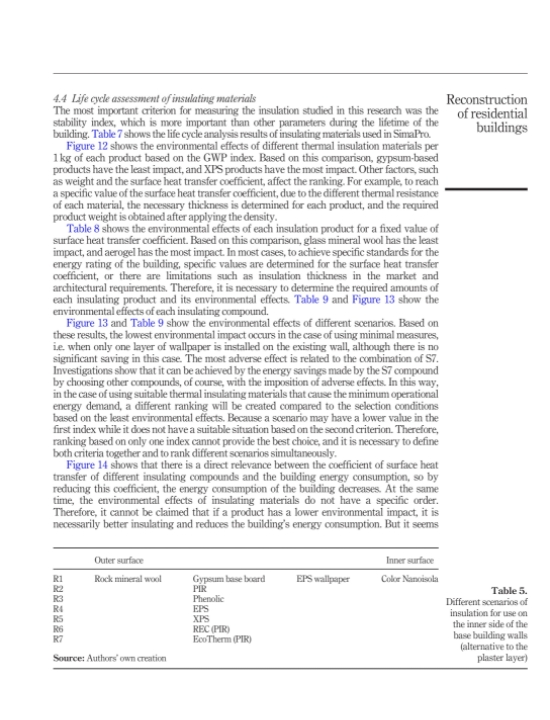
4.4 Life cycle assessment of insulating materialsThe most important criterion for measuring the insulation studied in this research was thestability index, which is more important than other parameters during the lifetime of thebuilding. Table 7 shows the life cycle analysis results of insulating materials used in SimaPro.Figure 12 shows the environmental effects of different thermal insulation materials per1 kg of each product based on the GWP index. Based on this comparison, gypsum-basedproducts have the least impact, and XPS products have the most impact. Other factors, suchas weight and the surface heat transfer coefficient, affect the ranking. For example, to reacha specific value of the surface heat transfer coefficient, due to the different thermal resistanceof each material, the necessary thickness is determined for each product, and the requiredproduct weight is obtained after applying the density.Table 8 shows the environmental effects of each insulation product for a fixed value ofsurface heat transfer coefficient. Based on this comparison, glass mineral wool has the leastimpact, and aerogel has the most impact. In most cases, to achieve specific standards for theenergy rating of the building, specific values are determined for the surface heat transfercoefficient, or there are limitations such as insulation thickness in the market andarchitectural requirements. Therefore, it is necessary to determine the required amounts ofeach insulating product and its environmental effects. Table 9 and Figure 13 show theenvironmental effects of each insulating compound.Figure 13 and Table 9 show the environmental effects of different scenarios. Based onthese results, the lowest environmental impact occurs in the case of using minimal measures,i.e. when only one layer of wallpaper is installed on the existing wall, although there is nosignificant saving in this case. The most adverse effect is related to the combination of S7.Investigations show that it can be achieved by the energy savings made by the S7 compoundby choosing other compounds, of course, with the imposition of adverse effects. In this way,in the case of using suitable thermal insulating materials that cause the minimum operationalenergy demand, a different ranking will be created compared to the selection conditionsbased on the least environmental effects. Because a scenario may have a lower value in thefirst index while it does not have a suitable situation based on the second criterion. Therefore,ranking based on only one index cannot provide the best choice, and it is necessary to defineboth criteria together and to rank different scenarios simultaneously.Figure 14 shows that there is a direct relevance between the coefficient of surface heattransfer of different insulating compounds and the building energy consumption, so byreducing this coefficient, the energy consumption of the building decreases. At the sametime, the environmental effects of insulating materials do not have a specific order.Therefore, it cannot be claimed that if a product has a lower environmental impact, it isnecessarily better insulating and reduces the building’s energy consumption. But it seemsTable 5.Different scenarios ofinsulation for use onthe inner side of thebase building walls(alternative to theplaster layer)Outer surface Inner surfaceR1 Rock mineral wool Gypsum base board EPS wallpaper Color NanoisolaR2 PIRR3 PhenolicR4 EPSR5 XPSR6 REC (PIR)R7 EcoTherm (PIR)Source: Authors’ own creationReconstructionof residentialbuildings


