


Page 10 - Demo
P. 10
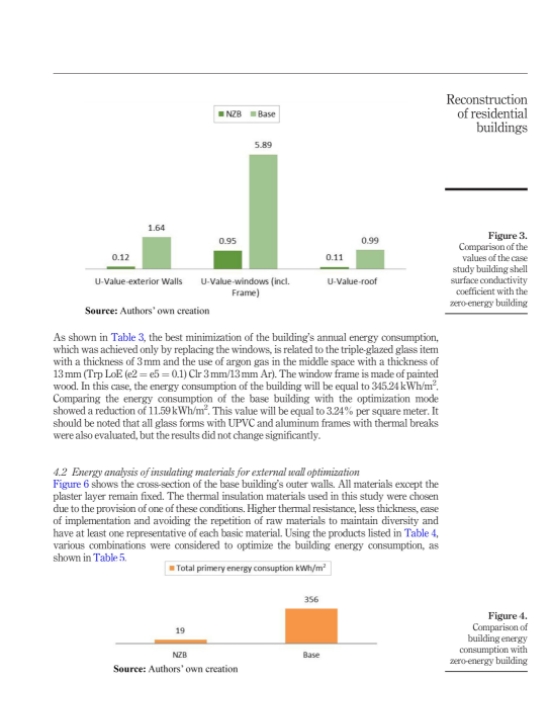
As shown in Table 3, the best minimization of the building’s annual energy consumption,which was achieved only by replacing the windows, is related to the triple-glazed glass itemwith a thickness of 3 mm and the use of argon gas in the middle space with a thickness of13 mm (Trp LoE (e2 ¼ e5 ¼ 0.1) Clr 3 mm/13 mm Ar). The window frame is made of paintedwood. In this case, the energy consumption of the building will be equal to 345.24 kWh/m2.Comparing the energy consumption of the base building with the optimization modeshowed a reduction of 11.59 kWh/m2. This value will be equal to 3.24% per square meter. Itshould be noted that all glass forms with UPVC and aluminum frames with thermal breakswere also evaluated, but the results did not change significantly.4.2 Energy analysis of insulating materials for external wall optimizationFigure 6 shows the cross-section of the base building’s outer walls. All materials except theplaster layer remain fixed. The thermal insulation materials used in this study were chosendue to the provision of one of these conditions. Higher thermal resistance, less thickness, easeof implementation and avoiding the repetition of raw materials to maintain diversity andhave at least one representative of each basic material. Using the products listed in Table 4,various combinations were considered to optimize the building energy consumption, asshown in Table 5.Figure 3.Comparison of thevalues of the casestudy building shellsurface conductivitycoefficient with thezero-energy buildingFigure 4.Comparison ofbuilding energyconsumption withzero-energy buildingReconstructionof residentialbuildings


