


Page 7 - Demo
P. 7
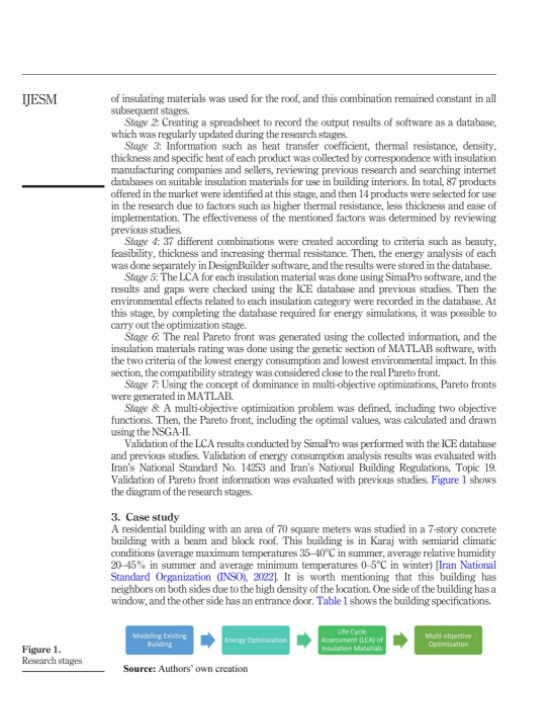
of insulating materials was used for the roof, and this combination remained constant in allsubsequent stages.Stage 2: Creating a spreadsheet to record the output results of software as a database,which was regularly updated during the research stages.Stage 3: Information such as heat transfer coefficient, thermal resistance, density,thickness and specific heat of each product was collected by correspondence with insulationmanufacturing companies and sellers, reviewing previous research and searching internetdatabases on suitable insulation materials for use in building interiors. In total, 87 productsoffered in the market were identified at this stage, and then 14 products were selected for usein the research due to factors such as higher thermal resistance, less thickness and ease ofimplementation. The effectiveness of the mentioned factors was determined by reviewingprevious studies.Stage 4: 37 different combinations were created according to criteria such as beauty,feasibility, thickness and increasing thermal resistance. Then, the energy analysis of eachwas done separately in DesignBuilder software, and the results were stored in the database.Stage 5: The LCA for each insulation material was done using SimaPro software, and theresults and gaps were checked using the ICE database and previous studies. Then theenvironmental effects related to each insulation category were recorded in the database. Atthis stage, by completing the database required for energy simulations, it was possible tocarry out the optimization stage.Stage 6: The real Pareto front was generated using the collected information, and theinsulation materials rating was done using the genetic section of MATLAB software, withthe two criteria of the lowest energy consumption and lowest environmental impact. In thissection, the compatibility strategy was considered close to the real Pareto front.Stage 7: Using the concept of dominance in multi-objective optimizations, Pareto frontswere generated in MATLAB.Stage 8: A multi-objective optimization problem was defined, including two objectivefunctions. Then, the Pareto front, including the optimal values, was calculated and drawnusing the NSGA-II.Validation of the LCA results conducted by SimaPro was performed with the ICE databaseand previous studies. Validation of energy consumption analysis results was evaluated withIran’s National Standard No. 14253 and Iran’s National Building Regulations, Topic 19.Validation of Pareto front information was evaluated with previous studies. Figure 1 showsthe diagram of the research stages.3. Case studyA residential building with an area of 70 square meters was studied in a 7-story concretebuilding with a beam and block roof. This building is in Karaj with semiarid climaticconditions (average maximum temperatures 35–40°C in summer, average relative humidity20–45% in summer and average minimum temperatures 0–5°C in winter) [Iran NationalStandard Organization (INSO), 2022]. It is worth mentioning that this building hasneighbors on both sides due to the high density of the location. One side of the building has awindow, and the other side has an entrance door. Table 1 shows the building specifications.Figure 1.Research stagesIJESM


