


Page 3 - Demo
P. 3
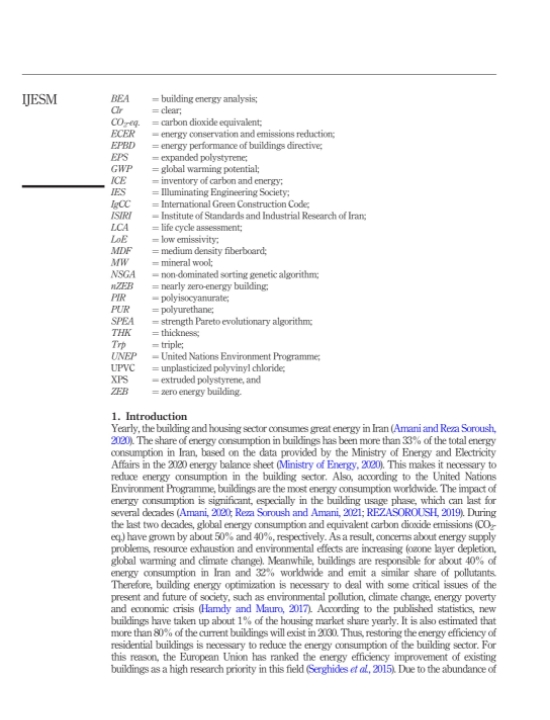
BEA ¼ building energy analysis;Clr ¼ clear;CO2-eq. ¼ carbon dioxide equivalent;ECER ¼ energy conservation and emissions reduction;EPBD ¼ energy performance of buildings directive;EPS ¼ expanded polystyrene;GWP ¼ global warming potential;ICE ¼ inventory of carbon and energy;IES ¼ Illuminating Engineering Society;IgCC ¼ International Green Construction Code;ISIRI ¼ Institute of Standards and Industrial Research of Iran;LCA ¼ life cycle assessment;LoE ¼ low emissivity;MDF ¼ medium density fiberboard;MW ¼ mineral wool;NSGA ¼ non-dominated sorting genetic algorithm;nZEB ¼ nearly zero-energy building;PIR ¼ polyisocyanurate;PUR ¼ polyurethane;SPEA ¼ strength Pareto evolutionary algorithm;THK ¼ thickness;Trp ¼ triple;UNEP ¼ United Nations Environment Programme;UPVC ¼ unplasticized polyvinyl chloride;XPS ¼ extruded polystyrene, andZEB ¼ zero energy building.1. IntroductionYearly, the building and housing sector consumes great energy in Iran (Amani and Reza Soroush,2020). The share of energy consumption in buildings has been more than 33% of the total energyconsumption in Iran, based on the data provided by the Ministry of Energy and ElectricityAffairs in the 2020 energy balance sheet (Ministry of Energy, 2020). This makes it necessary toreduce energy consumption in the building sector. Also, according to the United NationsEnvironment Programme, buildings are the most energy consumption worldwide. The impact ofenergy consumption is significant, especially in the building usage phase, which can last forseveral decades (Amani, 2020; Reza Soroush and Amani, 2021; REZASOROUSH, 2019). Duringthe last two decades, global energy consumption and equivalent carbon dioxide emissions (CO2-eq.) have grown by about 50% and 40%, respectively. As a result, concerns about energy supplyproblems, resource exhaustion and environmental effects are increasing (ozone layer depletion,global warming and climate change). Meanwhile, buildings are responsible for about 40% ofenergy consumption in Iran and 32% worldwide and emit a similar share of pollutants.Therefore, building energy optimization is necessary to deal with some critical issues of thepresent and future of society, such as environmental pollution, climate change, energy povertyand economic crisis (Hamdy and Mauro, 2017). According to the published statistics, newbuildings have taken up about 1% of the housing market share yearly. It is also estimated thatmore than 80% of the current buildings will exist in 2030. Thus, restoring the energy efficiency ofresidential buildings is necessary to reduce the energy consumption of the building sector. Forthis reason, the European Union has ranked the energy efficiency improvement of existingbuildings as a high research priority in this field (Serghides et al., 2015). Due to the abundance ofIJESM


